
“The American dream used to be getting married, having kids, and buying your own house. Now we’re seeing families coming back together under one roof out of necessity and choice,...

Downtown Pittsburgh Condos Sell for $200 Less Per Square Foot Than Those in the Strip District

Written by:
Date:
14 Sep 2026
Share via Facebook

Share via Linkedin

Share via X

Copy to clipboard

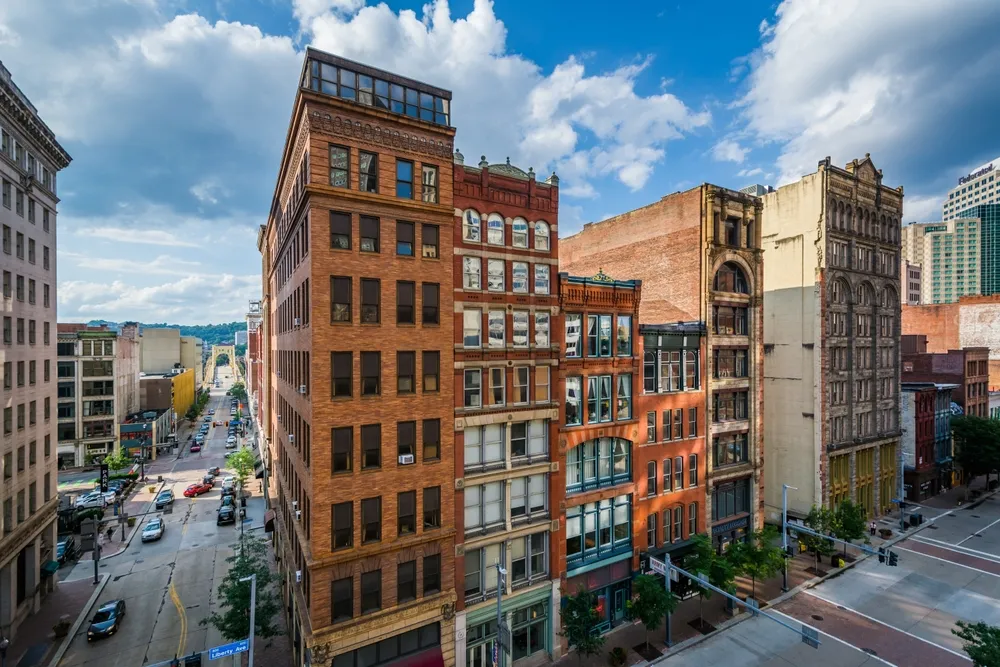
Condo prices in the Strip District average around $800,000, and townhomes there have sold in the $2 million range. A few blocks away in downtown Pittsburgh, per-square-foot prices run roughly $200 lower, according to Racheallee Lacek, team leader of the Lacek Group at Piatt Sotheby’s International Realty. That gap has created a pricing window attracting relocating professionals, empty nesters, and investors in a city where the post-pandemic commercial recovery is still translating into residential demand.
Lacek has worked in Pittsburgh’s urban residential market since 2010. Her career ignited with the Piatt Companies, a development family that began redeveloping the downtown core around 2008 and 2009. That redevelopment, adaptive reuse of industrial and commercial buildings, new construction condos, and more recently townhomes, reshaped what was once a business-only district into a residential neighborhood with a growing inventory of housing types.
A Compact City With an Expanding Residential Footprint
Pittsburgh’s physical size distinguishes it from other urban markets. “Pittsburgh Downtown core at its widest distance is a mile wide,” Lacek says. “I can walk from one side of the city to the other in half an hour or less.” That compactness means neighborhoods like the Strip District, the North Shore, Lawrenceville, and Mount Washington all sit within roughly 10 minutes of the downtown core, close enough that the residential market has expanded outward without losing the walkability and transit access that draws urban buyers.
The city’s buyer base reflects this accessibility. Lacek describes the dominant demographic as professionals in education, medicine, and technology, sectors with major employers spread across the city’s neighborhoods. Feeder markets include San Francisco, Portland, Seattle, Austin, Chicago, New York, Boston, Baltimore, and Washington, D.C. The common draw is affordability. “What you can buy here in Pittsburgh versus that same property in their city is about half, if not less than half of what they’re paying in their markets,” Lacek says.
Post-Pandemic Recovery Is Underway but Selective
Downtown Pittsburgh’s residential market took a harder hit than some peer cities during the pandemic. “Transitioning from 2020 into 2024 was a little difficult for Pittsburgh,” Lacek says. “We didn’t come back as quickly as some other cities did, but we are slowly turning around.”
The core problem was commercial departures. When employers left the downtown core, the middle of the market, buyers in the $500,000 to just-under-a-million range, left with them. That segment has been the slowest to return. But Lacek sees signs of reactivation: vacant storefronts reopening, businesses returning, and growing density attracting new retail. She points to a Target that opened downtown with a grocery section, something the city had previously struggled to support because of infrastructure constraints around delivery logistics and street access. “With Target opening up one of their small-format stores, the companies designed them for dense urban areas, which proved that a company like Target can sustain downtown Pittsburgh because the density is there,” she says.
State-level investment is also playing a role. Lacek cites a $600 million allocation by the governor directed toward the city region, which she expects to support both residential and commercial revitalization through grants and facade renovation programs.
What Out-of-Town Buyers Get Wrong
For buyers relocating from other metro areas, the most common surprise is what Downtown Pittsburgh’s older building stock cannot easily provide. “Buyers are surprised when they come here, and they see that parking is not integral,” Lacek says. “They see that they don’t have the opportunity for outdoor space or a window to open for fresh air.”
The constraint is structural. Downtown Pittsburgh was designed for industry and commerce, not residential use. Buildings tend to be narrow and deep, and digging underground for parking runs into the city’s three rivers. Buildings that do offer parking and outdoor space command a premium and see sustained demand, a detail that out-of-town buyers often underestimate when comparing Pittsburgh prices to those in their home cities.
The Mid-Rise Conversion Opportunity and Its Regulatory Constraint
For investors, Lacek sees the clearest opportunity in mid-rise office-to-residential conversions. She recently listed a building on Penn Avenue that she describes as a strong candidate. But a specific building-code requirement limits broader activity: Pittsburgh requires two stairwells for egress and ingress, while many of the city’s older mid-rise buildings were built with only one.
Lacek says case studies in cities like Austin, Texas, where mid-rise buildings are abundant and residential conversions are needed, suggest a path forward. In her view, that path involves seeking variances or code exceptions from the city, a process that has not yet been standardized locally. Combined with available grant programs, she sees conversion-ready buildings throughout the downtown core and its immediate corridors as an investment category worth watching.
Setting the Bar in the Strip District
The upper end of the market is establishing new benchmarks. Lacek recently sold a unit at 2500 Smallman, an 11-unit townhome development built inside a brick warehouse in the Strip District. The unit sold twice, first off-market through her network, then on the public market after the original buyer pulled out, and the second sale closed at a higher price than the first contract. “It was a very successful sale to set the bar in the market to show that our townhouses are valued in the $2 million range,” she says.
That price point, paired with Strip District residences averaging around $800,000, positions the neighborhood as the city’s luxury residential anchor, and sharpens downtown’s lower per-square-foot pricing as a contrast for buyers weighing location against cost. Lacek’s guidance is clear: ‘Buy downtown now while the entry point is favorable. You’ll benefit from immediate rental returns, and by the time you’re ready to move in, you’ll be established in a neighborhood that has already hit its stride.’
About the Expert: Racheallee Lacek is Team Leader of the Lacek Group at Piatt Sotheby’s International Realty and has worked in Pittsburgh’s urban residential market since 2010.
This article is based on information provided by the expert source cited above. It is intended for general informational purposes only and does not constitute legal, financial, or real estate advice. Readers should conduct their own research and consult qualified professionals before making any real estate or financial decisions.
Similar Articles
Explore similar articles from Our Team of Experts.