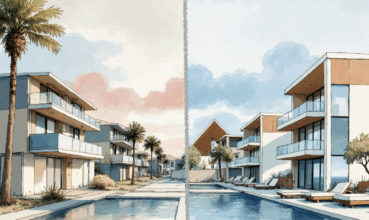
South Florida’s affordable housing shortage is forcing architects and developers to rethink how they design, finance, and operate new projects. The challenge goes far beyond cutting costs; it requires a complete recalibration of what makes a project viable in a market shaped by new workforce housing requirements and rising development expenses.
Nicolas Pinzon, Associate Principal at RSP Architects, says the central tension is evident: “You’re always juggling between affordability and profitability.” Developers must deliver housing that meets affordability standards while generating returns that justify the risks and costs of building in South Florida’s high-demand market.
Pinzon, who is working on several workforce housing developments across South Florida, explains that the recent Live Local Act and similar initiatives are increasing pressure to deliver affordable units. These policies require or incentivize developers to include a set percentage of below-market-rate homes in new projects, often in exchange for greater density or other zoning benefits. But the economics, he says, remain stubbornly difficult.
Dual Track Development
To manage these competing demands, many developers operate parallel teams for luxury and affordable projects. Pinzon notes that larger firms often maintain separate teams with specialized expertise for each segment. “They have their luxury products, which are very profitable and well understood, and then another team focused on affordable projects,” he says.
This separation goes beyond marketing. Affordable projects demand distinct design strategies. “You’re constantly redesigning spaces, rethinking costs, and adapting structures to make the numbers work,” Pinzon explains. Architects must be creative with layouts, materials, and building systems to keep projects within strict budget constraints without compromising on livability or long-term durability.
Unlike luxury developments, which allow higher margins for premium finishes and amenities, affordable housing projects must provide essential quality at the lowest possible cost. This often means working closely with contractors and suppliers to identify value-engineering opportunities and eliminate unnecessary expenses.
Navigating the Live Local Act
The Live Local Act has added new complexity to the design process. The law allows higher density for projects that include workforce housing, but also introduces unfamiliar regulatory requirements and approval processes. Pinzon describes a steep learning curve for both developers and architects as they navigate the new rules. “Developers and architects are still learning to interpret and implement these codes,” he says.
The real challenge, Pinzon adds, is not only meeting the letter of the law but also integrating workforce housing into financially viable projects. “Behind any of these projects, there’s an economic part that has to work for the developer and for the city,” he says. If the numbers don’t add up, projects stall or never break ground.
Mixed Use as a Financial Lever
One strategy gaining traction is integrating mixed-use elements. Pinzon says many Live Local projects now combine residential units with retail, co-working spaces, or offices. “They have housing, they have retail, and some include co-working or office space,” he explains.
Diversifying uses allows developers to offset the lower returns from affordable units. Retail and office components can command higher rents or sales prices, while amenities like shared workspaces make the entire project more attractive to both market-rate and affordable tenants. “A project that looks primarily residential is often actually a mixed-use project,” Pinzon says.
This approach also helps address concerns that affordable units may feel isolated or inferior. By embedding workforce housing in larger, amenity-rich developments, developers can create more integrated communities where residents share common spaces and services.
Cost Remains the Central Obstacle
Despite these innovations, Pinzon says that cost remains the overriding concern in every design meeting. “Cost and budget issues are always at the top of the list,” he says. Every decision, from structural systems to material choices and unit layouts, is shaped by the need to control costs.
Relentless cost pressure forces architects to make difficult trade-offs. The goal is to reduce expenses without sacrificing the units’ basic livability or appeal. If the balance tips too far toward cost-cutting, projects risk becoming unattractive to renters or buyers, undermining the very purpose of workforce housing initiatives.
Pinzon’s experience suggests that South Florida’s affordability crisis is not just about building more units. It requires a fundamental rethinking of how those units are designed, financed, and incorporated into larger communities.
Looking Ahead: Sustainability of the Market Model
It remains uncertain whether the industry’s current approach can scale to meet the region’s needs. Maintaining separate teams and design methods for luxury and affordable products suggests that most firms still treat them as distinct markets. Pinzon’s account highlights how much of today’s progress depends on constant creative problem-solving, rather than systematic solutions.
As workforce housing mandates become more common in South Florida, the pressure to find replicable, scalable models will only increase. RSP Architects is currently involved in several Live Local projects that could provide early answers about what works – and what doesn’t – as the region tries to address its housing crisis without driving away private investment.
For now, architects and developers are forced to work within ever-tighter margins, balancing affordability with the hard math of construction costs and profitability. The outcome of this balancing act will shape the next generation of housing in South Florida, and could set the tone for other high-cost markets grappling with similar challenges.
A dramatic migration pattern is reshaping the New York metropolitan area’s real estate landscape as residents seek more affordable alternatives to Manhattan and Brooklyn, according to ...
The days of chocolate chip cookies and Sunday-afternoon open houses may be numbered, according to one prominent Texas real estate leader who oversees nearly 3,000 agents across 14 offices. &...
Home prices in Jacksonville Beach have risen 12.8 percent year-over-year, far outpacing the broader Jacksonville market. However, condominiums in the area are experiencing a sharp downturn, ...
A single median price often summarizes Santa Barbara’s residential market, but this figure conceals a sharp divide between high-end luxury homes and the broader market. Combining sales fro...
The real estate industry is on the cusp of a dramatic shift in how agents manage client relationships, according to Cyrus Mohseni, Co-Founder & Vice President of Strategy and Growth at T...
CAMPBELL RIVER, British Columbia, July 18, 2024 (GLOBE NEWSWIRE) — Today, the Rental Protection Fund (the Fund) announces the acquisition of nine properties across Vancouver Island by ...