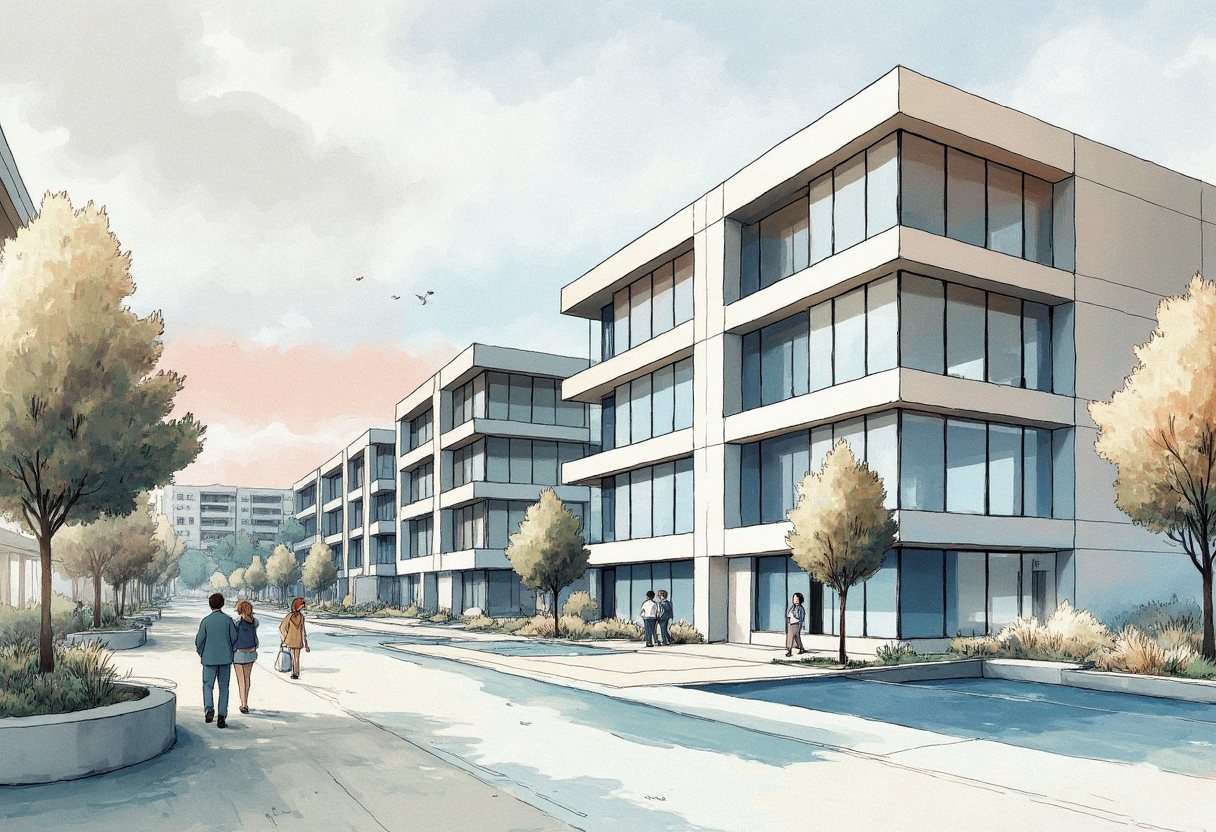
The suburban office market may emerge as an unexpected winner from the post-pandemic workplace evolution, according to a veteran commercial real estate finance executive who sees strong demand for quality space outside urban cores.
“Suburban office market, I think, in the long term, will have benefited in a weird way from COVID,” says Abraham Bergman, President of Eastern Union. “Not everybody has to be in downtown Manhattan or downtown Chicago anymore.”
Bergman points to his own company’s experience in Brooklyn’s Marine Park neighborhood as evidence of this shift. “There’s been a whole bunch of new office buildings that went up, and for the most part, they’re leasing phenomenally well,” he notes. “We’re talking about $45-$50, $55 rent per square foot.”
This success challenges the popular narrative of widespread office market distress, Bergman argues. While downtown vacancy rates have grabbed headlines, select suburban locations are seeing robust tenant demand.
“People recognize that complete remote working is not going to be at the level that people expected it to be,” Bergman says. He suggests that hybrid work models are driving demand for high-quality suburban office space that offers shorter commutes for employees.
According to Bergman, lenders are starting to recognize this bifurcation in the office market. “Office deals are starting to happen,” he notes. “For a number of years post-COVID, office was the retail of 2008, it was a dirty word. Nobody wanted to do office.”
While he cautions that office lending remains selective, Bergman sees increasing willingness among lenders to evaluate deals based on specific submarkets and property characteristics rather than avoiding the sector entirely.
Eastern Union recently put a mixed-use development under application in Florida that includes significant office space – a deal Bergman says would have been challenging to finance two years ago. “We had a number of offers on the deal, not just one,” he notes, crediting the location’s strong fundamentals and continued population growth.
“You have to realize that the number of transactions going on in the market is a mere fraction of what a normal market would see,” Bergman acknowledges. However, he suggests the suburban office narrative may be reaching an inflection point as more companies embrace hybrid work models that prioritize employee convenience.
The luxury real estate market has undergone a fundamental shift that most agents haven’t fully grasped, according to Rod Watson, founder of Distinct Concierge Real Estate. His recent $...
The real estate industry is witnessing a fundamental shift in how teams collaborate and share information, according to Trisha Roy of Open Spaces International Inc., who points to new commun...
Bonaventure’s Chief Growth Officer argues that one-size-fits-all approaches are misaligned with investor needs. The real estate investment industry’s tendency to offer standardiz...
The commercial real estate industry stands at a technological tipping point where network effects are dramatically amplifying the value of digital platforms, according to Steve LaMotte Jr., ...
The new construction market in South Florida has split into sharply distinct segments, with pricing strategies diverging to the point that communities across the street are operating in enti...
Industry veteran Jeff Beggins warns that a combination of federal and state policy shifts will soon drive a surge in demand for Florida residential real estate, leaving investors with fewer ...